IMPLANTOLOGY · DENTAL IMPLANTS DÜSSELDORF
Fixed teeth. Precisely planned, built to last.
Dental implants replace missing teeth permanently — from a single tooth to a complete jaw. At A+ Dental everything from diagnosis to the finished restoration is in one pair of hands: Dr. Rodríguez Ruíz, MSc.

What is a dental implant?
A dental implant is an artificial tooth root of titanium or ceramic anchored in the jawbone. A crown, bridge or denture is then attached to it. Properly planned and cared for, implants can last many years — they are today's standard for replacing missing teeth without grinding down healthy neighbours. Whether an implant suits you is determined by a personal examination.
DELAYED OR IMMEDIATE
Two routes to the same result — a fixed, natural-looking tooth.
In both cases the implant acts as an artificial tooth root carrying an individually made crown. The only difference is wann it is placed.
Delayed placement
For situations where the site must heal before the implant is placed.
ADVANTAGES
- Predictable long-term results
- Suitable for complex cases or existing infection
- Right where additional bone healing is needed
TYPICAL TREATMENT DURATION
4–8 months
Immediate placement
Where conditions are ideal, the implant is placed directly after extraction in the same appointment.
ADVANTAGES
- Fewer surgical procedures
- Preserves natural bone and gum contours
- Temporary crown possible the same day
TYPICAL TREATMENT DURATION
2–4 months
Not every jaw is suitable for immediate placement.
Which route is possible is decided by the clinical examination together with the 3D scan. Neither is a compromise — both end in the same fixed ceramic tooth.
What we check before recommending a route
Most patients are suitable for implant treatment. The examination decides which route gives the safest and most predictable result.
WHO IT SUITS
Typical starting situations.
One tooth missing
A single-tooth implant closes the gap without touching the neighbouring teeth.
Several teeth missing
Implant-supported bridges replace larger gaps firmly and stably.
Many or all teeth missing
With the All-on-X concept an entire jaw can be restored on just a few implants — often with fixed temporary teeth the same day.
All-on-X in detail →A denture that does not hold
Implants can anchor a loose denture securely — more hold when eating and speaking.
THE PROCESS
From the first examination to a fixed tooth.
-
01
Examination & diagnostics
Findings, radiographic diagnostics and assessment of bone volume — the basis of any serious implant plan.
-
02
Planning & cost clarity
Digital planning of the implant position, discussion of the alternatives and a transparent treatment and cost plan — before treatment begins.
-
03
Bone grafting if needed
If there is not enough bone it can be built up specifically — before or during placement, depending on the situation.
-
04
Placement
The procedure is carried out under local anaesthetic, usually in under an hour. The implant then integrates over several weeks to months.
-
05
Restoration & aftercare
The crown, bridge or denture is fitted and adjusted. Regular aftercare and prevention secure the result long term.
COSTS & FINANCING
What do dental implants cost?
In short: The cost depends on the number of implants, the bone available, the material and the type of restoration — a serious figure only exists after the examination. Before treatment begins you receive a written treatment and cost plan, which we go through together.
Statutory insurers pay a fixed subsidy towards tooth replacement; private and supplementary policies reimburse depending on the tariff. We help you with the paperwork. On request your treatment can be paid in instalments through our billing partner Nelly — we go through the terms with you in the consultation.
RISKS & LIMITS
Openly stated.
Like any surgical procedure, implant placement carries risks — impaired wound healing, or in rare cases loss of the implant. Smoking, untreated periodontitis and certain conditions can affect success. We explain everything fully and tell you honestly when a different solution would be better for you.
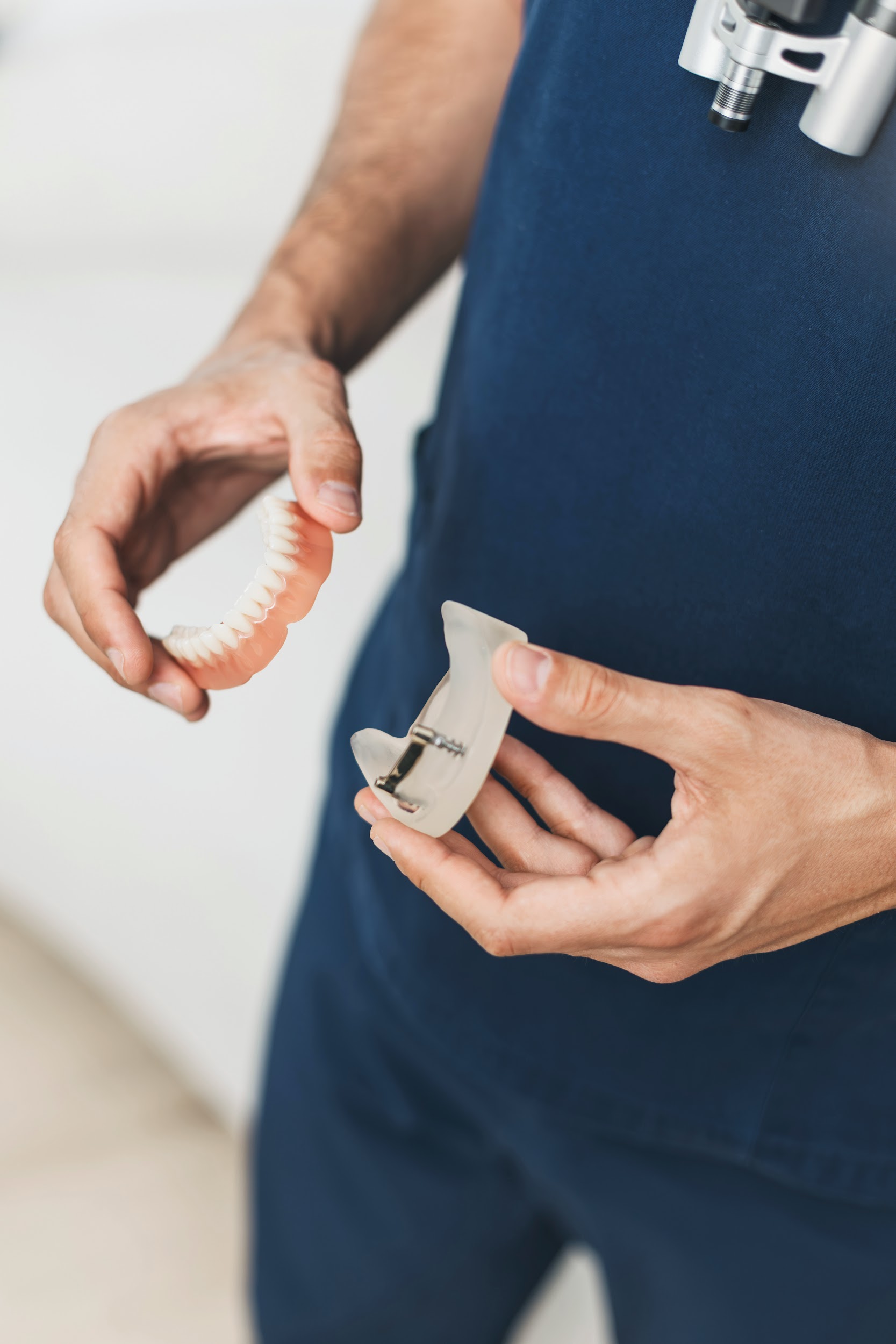
We work with established implant systems whose components will still be available in ten years. Which system suits your case is decided by the findings — not by a catalogue.
RISKS & INFORMED CONSENT
What can happen, before you agree.
Implants are among the best-documented procedures in dentistry and are uneventful in the overwhelming majority of cases. Even so, being informed belongs before the decision. We discuss these six points with you personally, based on your findings.
Integration that fails
RARE, BUT POSSIBLE
In rare cases an implant does not grow firmly into the bone. This shows in the first months. The implant is then removed, the site heals and a new implant can usually be placed after a few months — at no additional cost for the implant itself.
Nerve proximity in the lower jaw
THE REASON FOR 3D PLANNING
A nerve runs through the lower jaw, and its distance from the planned implant position determines the safety of the procedure. Temporary numbness in the lip or chin is possible; lasting impairment is rare. That is precisely why we plan in three dimensions and work with a surgical guide, rather than estimating at the chair.
The sinus in the upper jaw
PLANNED FOR, NOT A SURPRISE
In the molar region of the upper jaw the sinus often sits close above the bone. Whether a sinus lift is needed is established before the procedure, not during it — the scan shows it.
Periimplantitis
THE REAL LONG-TERM RISK
Implants do not get decay, but the tissue around them can become inflamed. If that goes unnoticed, bone is lost, and that loss is not recoverable. This is why aftercare appointments for implants are not an add-on but part of the treatment.
Smoking
THE STRONGEST FACTOR YOU CONTROL
Nicotine reduces blood supply to the tissue and measurably increases the rate of healing problems and peri-implantitis. We raise this before the procedure, not after — and look together for a realistic approach for the weeks around surgery.
Pre-existing conditions
NOT A DISQUALIFIER, BUT A FACTOR
Poorly controlled diabetes, certain osteoporosis medications and untreated periodontitis all affect integration. None of them rules out an implant in principle, but all of them belong before the planning, not after.
This overview does not replace a personal consultation. Before every procedure we discuss your findings, the alternatives and the risks relevant to you individually — in German, Spanish, English or Portuguese.
FREQUENTLY ASKED QUESTIONS
Implants — answered briefly.
PRINTABLE INFORMATION SHEETS
Everything to read and print — before the decision and after the procedure.
A4 documents in four languages. No sign-up, no email address.
-
Dental implants
Structure, process and what determines durability.
-
After a surgical procedure
Cooling, eating, care — and the warning signs.
-
Implantatpass & Nachsorge
Your aftercare plan and care at home.
-
Understanding your cost plan
Fixed subsidy, your share and the right questions to ask.
ONE LEVEL DEEPER · 4–5 PAGES
Patientenbroschüre „Dental implants"
Process, timeframe, limits and the most common questions as an A4 document — short version (4 pages) directly, detailed version (13 pages) in German, English and Spanish. The sheet above summarises the essentials on two pages; this brochure goes considerably deeper.
Find out what is possible in your case.
Describe your situation to us in a few steps — without obligation, discreetly and with no waiting room.